
Kitchen Design Guide
Gola Profile Kitchen Cabinets: The Handleless System, Explained
Gola profile kitchen cabinets have no knobs and no pulls — nothing interrupting the surface, just clean, continuous fronts from wall to wall. Here's how the handleless system actually works, and why it stays fingerprint-free.
Walk into a modern kitchen and something feels different before you can name it. The cabinets have no handles. Your eye travels across the whole run without stopping.
That's a gola profile. And once you understand how it works, you'll start seeing it everywhere.
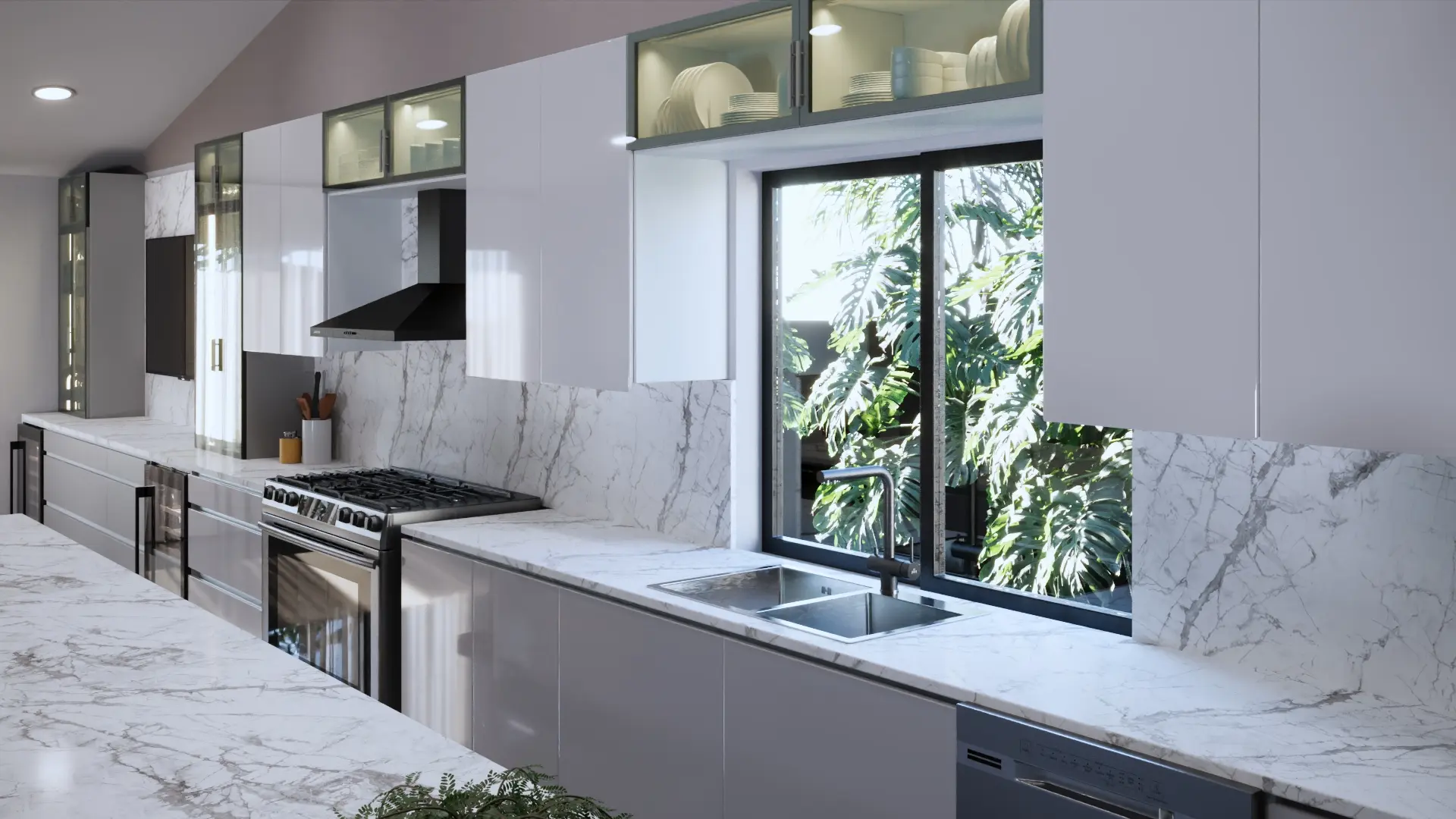
What Exactly Is a Gola Profile Kitchen Cabinet?
A gola profile is a channel — usually an extruded aluminum section — recessed between cabinet fronts. Instead of reaching for a handle, you reach into the channel. Your fingertips find the back edge of the door, and it opens.
The word comes from Italian, where gola means throat. It's a good description: a narrow opening carved into the cabinetry itself.
The profile does two jobs at once. It gives your hand somewhere to go, and it gives the design a crisp horizontal shadow line that reads as intentional rather than accidental. It's one of several door systems we build into our custom kitchen cabinets.
Cut view from the side. In both cases the fingers touch only the edge of the door, never its flat face.
The rule that explains everything
Here's the part that confuses people at first, and it's simpler than it sounds.
Top on bottom, bottom on top
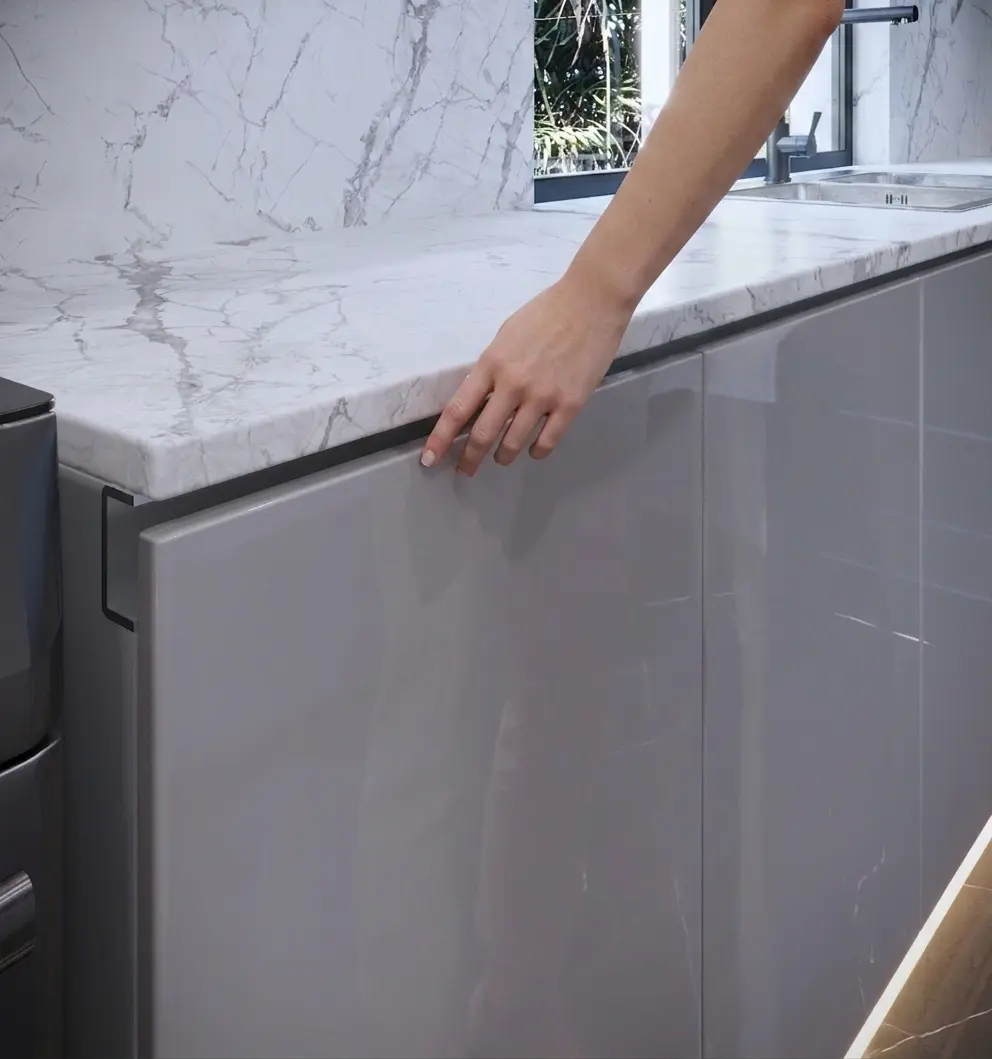
On base cabinets, the channel sits at the top — right under the countertop. You reach down into it.
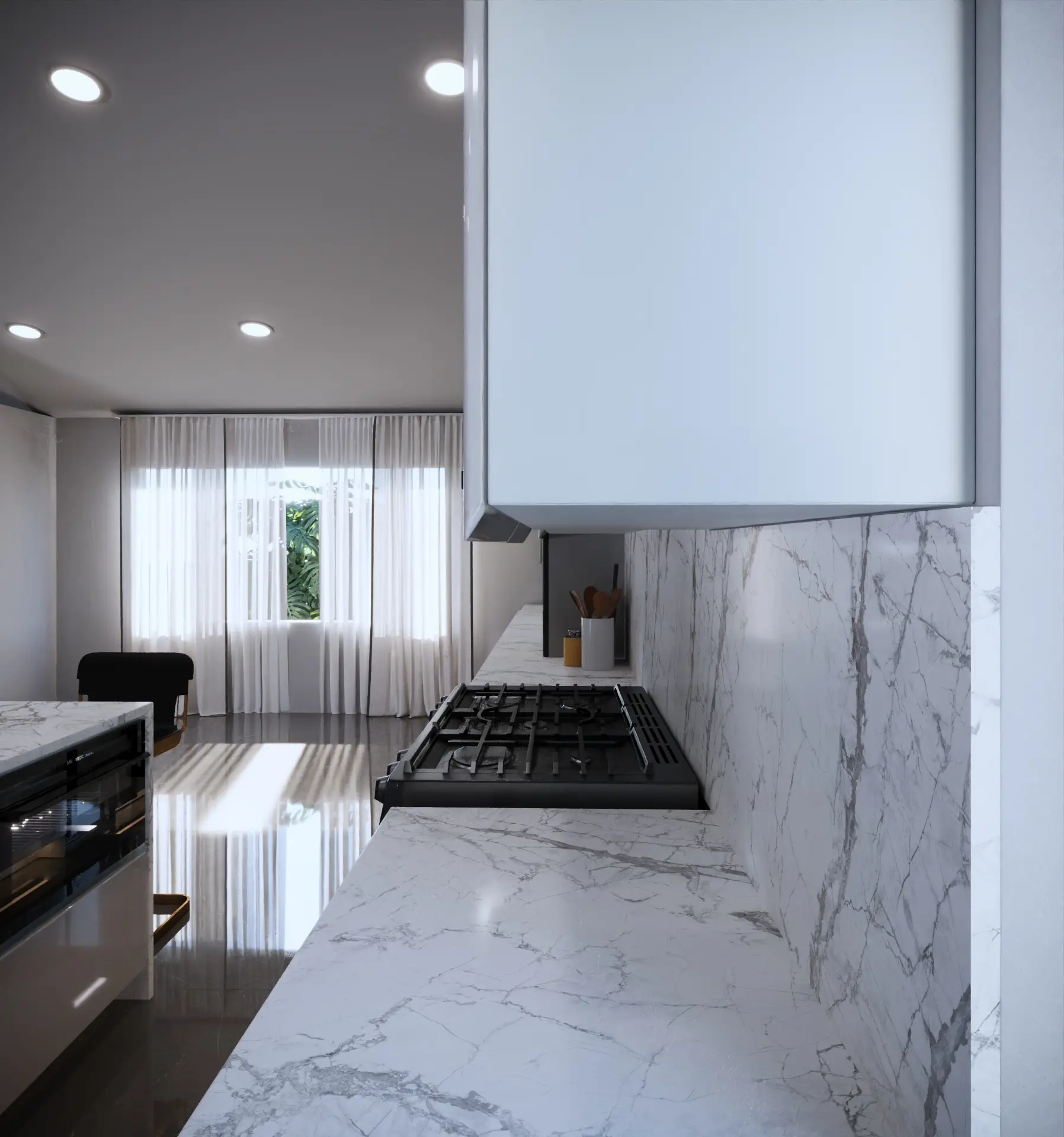
On upper cabinets, the channel sits at the bottom. The door front extends slightly below the cabinet box, and you reach up underneath it.
In both cases you're approaching the opening from the direction your hand naturally travels. And in both cases your fingers touch the edge of the door, not the face of it. That single detail is why gola kitchens stay clean.
See it with and without the countertop
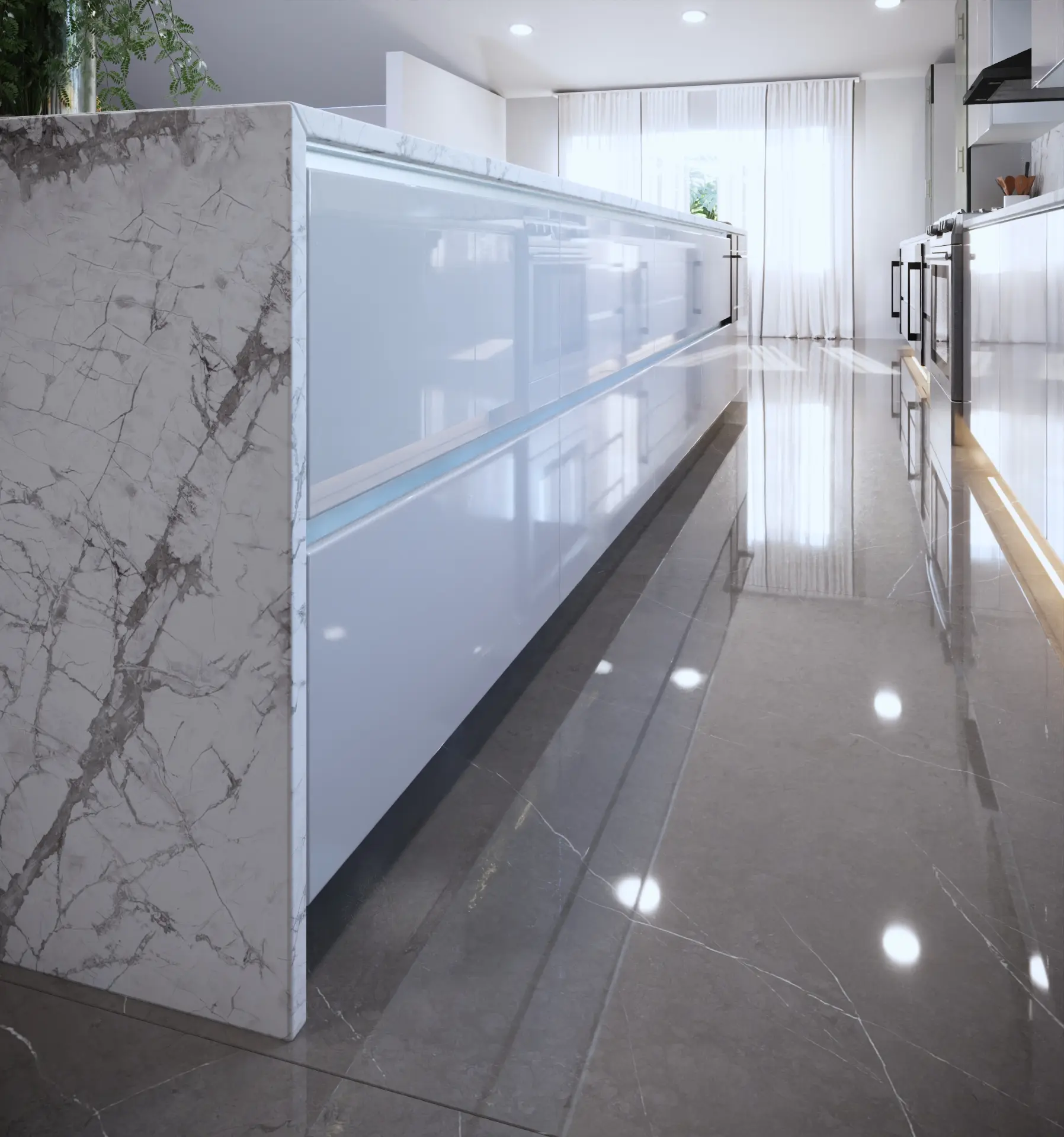
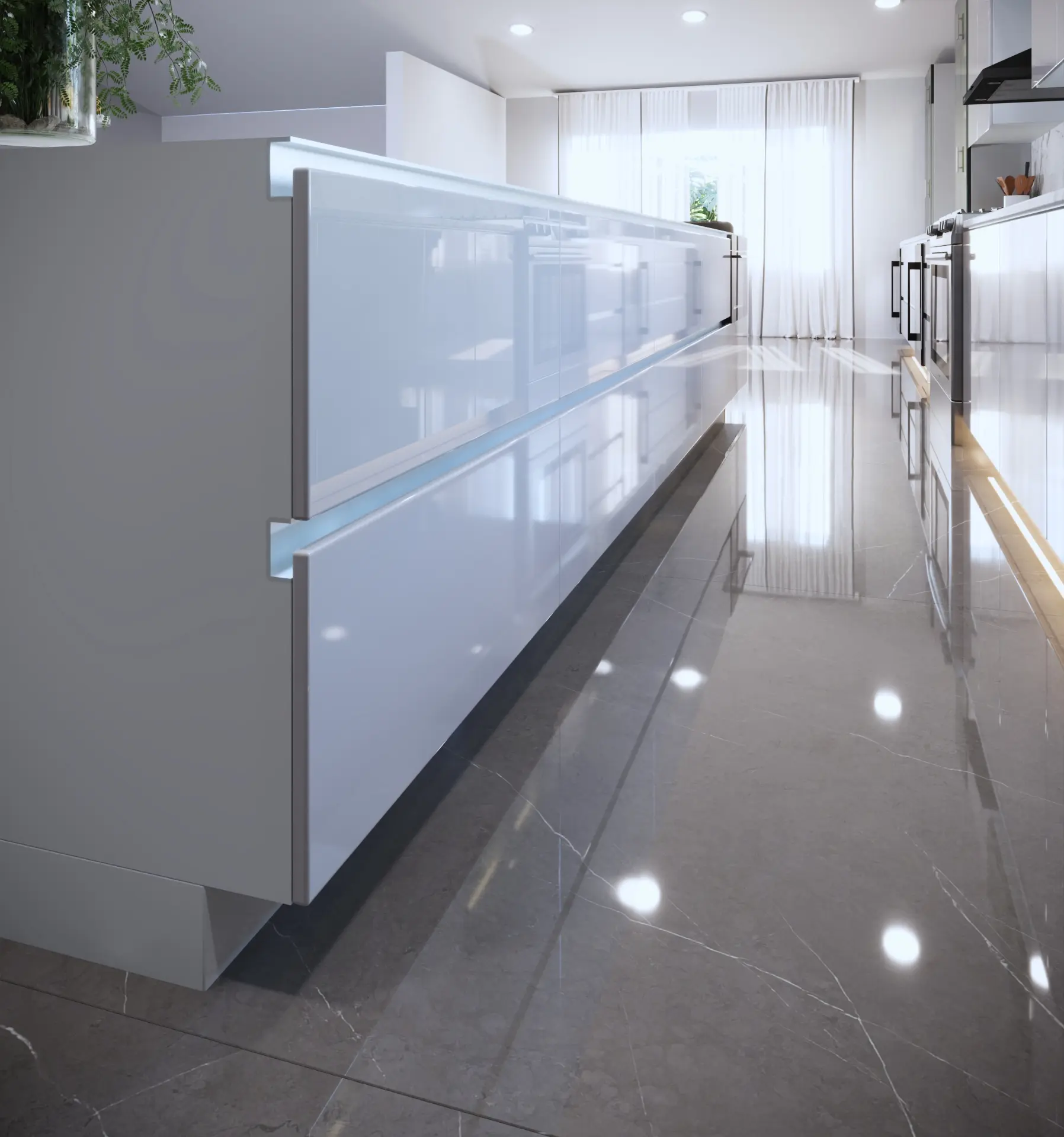
The channel is easy to miss in a finished kitchen, because the countertop overhang shades it into invisibility. Drag the slider below: on one side the countertop is removed so you can see the aluminum profile clearly, on the other it's installed exactly as it would be in your home.
 Profile exposed
Countertop installed
Profile exposed
Countertop installedNotice the LED strip running inside the channel on the left side. Because the profile is already a recess, it's the natural place to integrate lighting — no extra housing, no visible fixture.
Every kind of front, and how each one opens
A real kitchen isn't one type of door repeated forty times. It's a mix — tall pantry columns, wide drawer banks, upper doors that swing, upper doors that lift. The gola system handles all of them, but each behaves a little differently.
Drawers
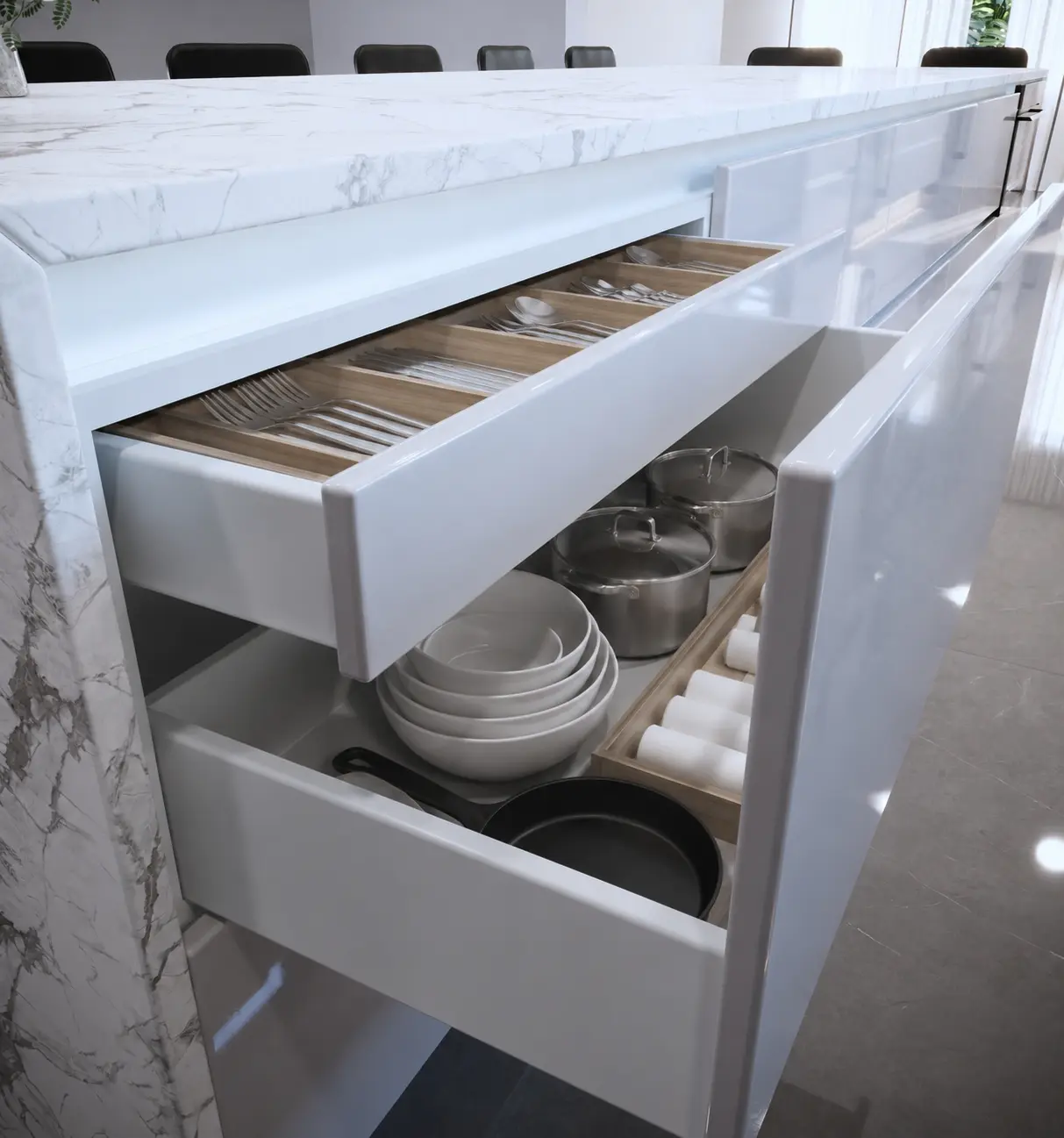
Drawers are where gola looks best. A bank of drawers with no hardware becomes a stack of clean horizontal bands, separated only by shadow lines.
The top drawer uses the same under-counter channel as the doors. Each drawer below carries its own channel along the top edge of its front. The result is a rhythm of thin dark lines that reads as deliberate design rather than missing hardware.
Base cabinet doors
Same principle. The channel runs along the top of the door, tucked under the countertop overhang. You reach down, hook your fingers, and pull.
Because the channel is shaded by the counter above it, it disappears visually. From standing height you see one uninterrupted plane of cabinetry.
Upper cabinets
On uppers the geometry flips. The door front drops below the cabinet box, and you reach up and behind that lower lip. Your fingers hook the back face of the edge and the door swings or lifts open.
Wide upper cabinets often work better lifting up than swinging sideways — no door hanging into the room at head height. Those use hinged support arms inside the cabinet that carry the weight and hold the door at any position. You still open it the same way: fingertips into the channel, then push upward.
What gola is not
Two things get bundled with gola that are actually separate systems. Untangling them makes it much easier to talk through your own layout.
| System | What it does | Where your hand goes |
|---|---|---|
| Gola profile | A recessed channel built into the cabinetry that replaces the handle | Into the channel, touching only the door edge |
| Lift-up hardware | Hinged arms that carry a wide upper door and hold it open | Anywhere — it's a hinge, not an opening method |
| Push-to-open | A latch that releases when you press the front | Flat against the door face, every single time |
That last row is the important one. Push-to-open looks even cleaner than gola on paper, but you press the face of the door to open it — which is precisely what a gola kitchen is designed to avoid.
Why homeowners choose it
Fingerprints stop being a daily problem
Your fingers only ever touch a thin edge, usually shaded and out of sight. On dark or high-gloss fronts — the finishes that show every mark — this is the difference between wiping down the kitchen daily and barely thinking about it.
There's nothing to catch on
No hardware at hip height to snag a pocket or a dish towel. In a galley kitchen where people move past each other constantly, that matters more than it sounds.
Cleaning gets simpler
A flat front wipes in one pass. No hardware to work around, no seams where grease collects around a screw base.
The room looks larger
Uninterrupted horizontal lines pull the eye across the space instead of stopping it every eighteen inches. In South Florida homes with open layouts, where the kitchen is visible from the living area, that continuity does real work. It's the same reasoning behind the handleless fronts we use on many custom walk-in closets.
What to think about before you commit
Gola isn't automatically the right answer, and it's better to know the tradeoffs now than after installation.
The channel collects. Crumbs, dust, the occasional drop of oil near the cooktop. It wipes out easily, but it is a surface that exists and needs attention.
It asks for precision. The whole effect depends on alignment. If the channels don't line up across the run, or the reveals between doors vary, the eye catches it immediately — there's no hardware to distract from the geometry. This is a system that rewards accurate manufacturing and punishes sloppy work.
It reads modern. In a traditional or transitional kitchen, handleless fronts can feel out of place. If you're set on shaker doors and a farmhouse sink, gola probably isn't your system.
Built in our own South Florida facility
Because a gola kitchen lives or dies on precision, it's the kind of project where manufacturing control matters most.
Every kitchen we build is cut, edge-banded and assembled in our own Coral Springs facility — our machines, our team, our tolerances. Nothing is ordered in from a third-party factory and hoped for. When channel alignment across a twelve-foot run is the design, that control is the difference between a kitchen that looks intentional and one that looks almost right. You can see the full process on our How It Works page.
See your kitchen before we build it
Free in-home consultation and a free 3D design — so you can see the finished lines before anything is cut.
Get Your Free 3D Design Or explore all our custom kitchen cabinet options →Common questions
Does a gola kitchen cost more?
Usually a little. The aluminum profile costs more than a set of handles, and the fabrication tolerances are tighter. On most projects the difference is modest relative to the overall kitchen.
Can I add gola to my existing cabinets?
No. The channel has to be built into the cabinet structure and the door dimensions calculated around it. It's a decision made at the design stage, not a retrofit.
Does the channel get dirty?
It collects dust and crumbs like any recess. A wipe with a damp cloth clears it. Near the cooktop it needs slightly more attention.
Do the doors close softly?
That's the hinge, not the profile. We fit soft-close hardware as standard on both doors and drawers.
What finishes work best with gola?
High-gloss and supermatte laminates are the natural pairing — they emphasize the flat plane, and the low-touch design keeps them looking clean. Wood-look laminates work well too, especially where the grain runs continuously across a bank of drawers.
Can lighting be built into the channel?
Yes, and it's one of the best reasons to choose the system. Because the profile is already a recess, an LED strip sits inside it with no additional housing and no visible fixture.